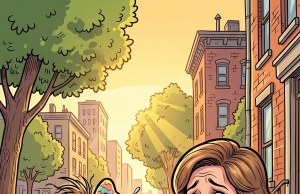
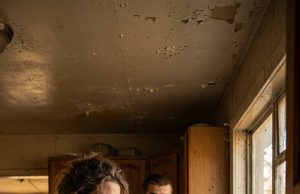
I found my twelve-year-old granddaughter doing her homework locked in the bathroom, sitting on the toilet lid, with her notebook on her knees.
I don’t know how long I stood in the doorway. My hand was on the doorknob, and I wouldn’t let go. Emilia didn’t even hear me come in.
Why would a little girl hide in a locked bathroom to make partitions when there’s a big table in the living room? That’s what I wondered. And nobody in that house wanted to answer me. Not my son. Not his wife. Not even Emilia herself.
Emilia is a quiet girl. The kind who greets you with a kiss and says thank you even if you just give her a glass of water.
Three months earlier, my son Miguel had called to ask if he could stay at my house in Coyoacán. He said it was while some things were being fixed at his place. I cried tears of joy. I hadn’t seen my granddaughter on Sundays for years.
I thought the house was finally going to have the noise of a little girl again.
On the first day, Emilia helped me make the bed. She asked for bread with sweetened condensed milk, like when she was little. I made it for her. She sat with me in the kitchen and told me about her school.
And now there she was, bent over the toilet, writing with her backpack between her feet.
I told her to leave, that she was uncomfortable there. She said she was used to it by now.
She had gotten used to it. A twelve-year-old girl.
I didn’t sleep that night. And I started gathering things I hadn’t wanted to see before.
At dinner we always set four plates. But Sara, my daughter-in-law, hardly touched hers. She’d get up with a tray of food and disappear down the hall. I thought she was just being stubborn.
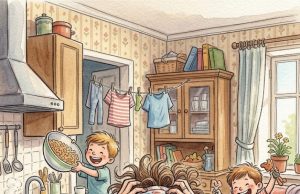
The dirty laundry didn’t add up either. There were tiny blouses and youthful pants that weren’t Emilia’s or Sara’s. When I asked, Sara told me they were her old clothes. Sara wears a different size. I stayed quiet.
And then there was the back room. The one Miguel kept locked from day one.
—It’s the office, Mom. There are papers. Don’t go in.
My son never had an office in his life.
One afternoon there was a loud bang in there. Something heavy fell to the floor. I asked who was there. No one answered me.
I had been sleeping a few meters from that locked room for three months, and only that morning did I dare to ask myself who they had locked inside.
The next day I caught Miguel alone in the kitchen, before he left.
—Why does Emilia do her homework in the bathroom?
—She wants privacy, Mom. Leave her alone.
—Why is there a locked room in my house?
She put the cup down on the table. She didn’t turn to look at me.
—Mom, there are some things that are better left unsaid.
—It’s my house, Miguel.
“And they’re my family.” Then he looked at me. “You said something one day. That’s why we’re like this. Don’t make me repeat myself.”
My hands were freezing and I hadn’t even noticed.
The day before, I had asked Emilia why she was hiding. The little girl burst into tears. She told me she couldn’t tell me. I asked her why not. She said, “Because Daddy said you wouldn’t understand.”
I don’t know where from, but as soon as Miguel left, I went into the hallway and turned the doorknob to the room at the end. Lock. I pressed my ear to the door.
From the other side, there was breathing. Soft. Like someone asleep.
I said “hello?” quietly, like a fool.
Breathing stopped.
That afternoon I sat down to have a snack with Emilia. I talked to her about school, her friends, everything except the bathroom and the room. I didn’t want to scare her.
She told me she got a perfect score in math. I told her she was my smart girl. She hugged me tightly, like when I was little.
For a moment I thought I was just making up a story. That maybe it really was an office. That maybe Sara really does eat in her room. That an old woman just imagines things.
I went to bed feeling more at ease.
In the early hours of the morning, I was awakened by footsteps. Barefoot, soft, in the hallway. And Sara’s voice, soft, speaking to someone:
—Yes, my love. It’s over now. I’m here.
The next morning Miguel left early. I peeked into Emilia’s room: she was still asleep, hugging her pillow.
But from the hallway came Sara’s voice again. Sweet. Like Mom’s.
—Good morning, my love. Did you sleep well? Open your mouth for me.
My granddaughter was asleep in front of me. So, who was Sara talking to?
I walked to the half-open door of the back room. I pushed it open slowly. Sara was standing with her back to me, feeding someone sitting on the floor. Someone I couldn’t see.
Sara turned around. And finally I saw who had been locked up in my own house for three months:
She was a girl. She looked about fifteen. She was sitting on a mat on the floor, with long black hair, playing with a piece of wood in her hands. Sara was feeding her, spoonful by spoonful.
I didn’t understand anything. I saw the girl but I didn’t understand what she was doing in my house.
The walls were lined with padding, like in a hospital. Thick curtains, a small lamp with a dim light, colorful balls, and large headphones hanging from a nail.
—Sara —I said, and that was all I could manage.
Sara got up slowly. She wasn’t scared. She was tired.
—Teresa… this is Lilia.
—I don’t have another granddaughter.
“Yes, she does,” said a voice behind me.
It was Emilia. Standing in the doorway, in pajamas, with swollen eyes.
—She’s my sister, Grandma.
I sat down in a little child’s chair that was there. I don’t know why I sat there. It was the only one there.
Lilia glanced at me for a second and returned to her wooden room. She wasn’t afraid of me. But she didn’t really know me either.
And then it all clicked for me.
The four trays of food. The youthful clothes that weren’t Emilia’s. The footsteps in the early morning. The knock I heard behind the door that day.
And Emilia. My Emilia doing her homework sitting on the toilet, with the door closed, for three months.
“Why were you hiding in the bathroom?” I asked him.
He wiped his nose with his sleeve.
—The sound of the pencil hurts Lilia. Sometimes she hits her head when there’s a loud noise. The bathroom door is thick. You can hardly hear anything in there.
A twelve-year-old girl had locked herself in a bathroom for three months so her sister wouldn’t cry. And I, meanwhile, slept peacefully on the other side of the wall.
I didn’t finish asking what I wanted to ask. I couldn’t get it out.
Sara knelt in front of me and grabbed my hands. They were freezing cold and I hadn’t even noticed.
—Teresa, Lilia is my daughter. She’s fifteen years old. She’s autistic. Severely. She doesn’t speak. But she understands everything. She’s very smart.
—Your daughter? Miguel told me you didn’t have any children.
—Miguel lied. Because of you.
That word hit me strangely. For me.
“Five years ago, when Miguel told you he was marrying me, you said something at the table. That raising a girl who wasn’t his blood was a burden. That a troubled daughter would ruin his son’s life.”
I remembered. My God, of course I remembered.
“Miguel was scared,” Sara continued, slowly, as if explaining it to a child. “When we came here for Lilia’s therapy, he told me: ‘We can’t tell my mom. If she finds out Lilia is coming with us, she’ll kick us out. It’s better to take care of her without her noticing.’”
That’s why the trays. That’s why they waited for me to go for my walk in the mornings. That’s why the room was closed.
They didn’t hide a little girl because they were bad. They hid her because they were afraid of me.
My son didn’t lie to me to hurt me. He lied to me so that I wouldn’t hurt her.
I covered my mouth with my hand. I couldn’t speak.
Lilia put down her piece of wood. She picked up a notebook that was next to her and opened it. She handed it to me without looking me in the eye.
It was a drawing. A family holding hands: Miguel, Sara, Emilia, and her. All with their little smiley faces. And in the far corner, all alone, a woman.
“That’s you, Grandma,” Emilia said softly. “Lilia asks about you in her own way. She draws you, but always from afar.”
I was left holding the notebook. One corner of the page got wet and I hadn’t even noticed.
I got down from the little chair and knelt on the mat, slowly, so as not to scare her.
—Forgive me, Lilia. I spoke of you without knowing you. They hid you because of me.
She didn’t answer me. She couldn’t. But she tilted her head toward my hand, slowly, as if asking me to leave it there.
And she smiled. A small smile. But a genuine one.
“She liked you,” Emilia said, her voice breaking. “Grandma, Lilia almost never smiles at someone new.”
I hugged her gently. She smelled like baby soap. Emilia joined the hug. The three of us there, on the floor of that room I had imagined as a prison.
And it wasn’t a prison. It was the only place in the world where that girl felt safe.
I heard the front door open. Miguel had already returned from work.
He went upstairs quickly. He saw the bedroom door open. He saw me, kneeling, hugging Lilia.
He stood frozen in the frame. White. Like a kid who’s been caught.
“Mom…” she said. Nothing more than that.
I got up as best I could.
—I’ve already met her, son. I’ve already met Lilia.
I couldn’t read his face. Fear, relief, both. Sara went to him and grabbed his arm.
For a moment I felt that everything was going to be alright. That the worst was over. That from then on we were going to be a family with five at the table.
Miguel came closer. But he didn’t hug me.
He knelt before me on the floor, just as I had knelt before his daughter. And he began to speak in a voice I didn’t recognize.
—Mom, there’s something I never told you. Lilia is not just Sara’s daughter.
He squeezed both my hands.
—The week you said at that table that a girl like that was a burden, I had already signed some papers. Papers that even Sara didn’t know about yet.
She swallowed. Her chin was trembling.
—You didn’t call someone else’s child a “burden,” Mom. And you still don’t know what I signed that week:
Part 3.
—They were adoption papers.
Miguel said it without letting go of my hands.
“I decided to adopt Lilia before I married Sara. The week I came to your house to tell you about the wedding, I had already started the process. Lilia has had our last name for five years now, Mom. She’s my daughter. Legally, on paper, everything.”
I didn’t say anything. I was putting the pieces together in my head, and they just didn’t add up because they hurt so much.
—So… —I began.
“Yes,” said Miguel. “Lilia has been your granddaughter for five years. Just like Emilia. You’ve had a granddaughter for five years that you didn’t even know you had.”
And the first time I heard of her, without knowing her name, without knowing her face, I said she was a burden.
I remained silent for a long time. I don’t know how long.
Miguel didn’t say anything to me. That was the worst part. If he had yelled at me, maybe it would have hurt less.
“After that dinner, I stopped calling you often,” he said, his voice now softer. “Not because I didn’t love you anymore. Because I had to choose. And I chose my daughters. Both of them.”
Sara was standing behind him, crying silently.
“I had to say I didn’t have children,” she said. “To the doctor, to the neighbors over there, to everyone. Denying my own daughter so no one would judge me. You don’t know what that’s like, Teresa.”
No, I didn’t know that. All I knew how to do was judge.
That night I understood something that was hard to swallow. The monster my son hid in that room for three months wasn’t Lilia. It was me.
I didn’t defend myself. I didn’t make excuses. At that age, you don’t have time to lie to yourself.
Things in my house slowly began to change.
The first thing I did was take the key out of the back room door. I threw it away myself.
We put up special blackout curtains in the living room. We set up a corner for Lilia’s therapy sessions. Emilia went back to doing her homework at the big table, with her lamp and her colors, just as it should have been from the beginning.
And I started taking Lilia to the park every morning. At first, we’d walk for ten minutes, and that was it. She’d stop to look at a leaf, to listen to a bird, to touch the bark of a tree. I learned not to rush her. I learned that loving someone also means respecting their way of doing things.
I even started volunteering at the school where Sara works, a special education school. I met children who don’t speak, children who scream when they’re scared, children who express their feelings through drawings. Before, I would have said, “Poor things.” Now I know they’re not a burden. They’re whole people, with a whole world inside them, waiting for someone to have the patience to understand them.
We celebrated Lilia’s sixteenth birthday at home. No loud music, no popping balloons, no crowds. Just the five of us, a chocolate cake, and a song sung softly.
When she blew out the candle, we all clapped softly. Lilia stood up, walked over to me, and hugged me. All by herself. Without anyone telling her to.
Miguel covered his face.
—Thank you, Mom.
“Don’t thank me,” I told him. “You taught me what it means to be family.”
A few days later, my neighbor found it at the gate.
—Doña Teresa, and that little girl?
—It’s my granddaughter Lilia.
—I didn’t know I had another granddaughter.
“I didn’t understand it before either,” I told him. “Now I do.”
A year has already passed.
Lilia no longer lives behind a closed door. Her room is always open. The neighbors greet her by name. Emilia brags about her sister to her friends. Miguel no longer walks around the house as if he owes something. Sara no longer apologizes to me with her eyes. And I no longer talk about blood as if it were the only thing that unites people.
This morning Lilia showed me a new drawing. A big house, with five people holding hands at the window. She pointed to my figure, then put her hand on her chest, and then put my hand on mine.
I didn’t need anyone to translate for me. Our hearts were together.
Tonight we set five plates on the table. Lilia sat next to me. When I served her, she gently touched my hand. That’s her way of saying thank you.
And when I passed by the back room, with the door wide open, I heard her humming softly, breathing calmly. The same breathing that one day stopped on the other side of that door because I said “hello?” like an idiot.
If you have someone who’s been pushed away because of something you said years ago, don’t wait until it’s too late. I almost was. Almost.